

Turquoise


Turquoise (Firoza)
 Get photos/videos on Whatsapp
(Inclusive of all taxes)
SELECT YOUR RING
Select a ring to claim your free gift.
FREE Ring
Free
₹2,999
You unlocked a free ring!
The Ring option is selected. Choose your ring size to complete your free gift.

Turquoise
(Firoza)
| Indian Size | Circumference | Diameter | ||
|---|---|---|---|---|
| Inch | mm | Inch | mm | |
| 1 | 1.61 | 41.01 | 0.51 | 13.1 |
| 2 | 1.64 | 42.70 | 0.52 | 13.3 |
| 3 | 1.69 | 42.90 | 0.54 | 13.7 |
| 4 | 1.72 | 43.60 | 0.55 | 13.9 |
| 5 | 1.76 | 44.80 | 0.56 | 14.3 |
| 6 | 1.81 | 46.10 | 0.58 | 14.7 |
| 7 | 1.87 | 47.40 | 0.59 | 15.1 |
| 8 | 1.89 | 48.00 | 0.60 | 15.3 |
| 9 | 1.92 | 48.70 | 0.61 | 15.5 |
| 10 | 1.97 | 50.00 | 0.63 | 15.9 |
| 11 | 2.02 | 51.20 | 0.64 | 16.3 |
| 12 | 2.04 | 51.90 | 0.65 | 16.5 |
| 13 | 2.09 | 53.10 | 0.67 | 16.9 |
| 14 | 2.14 | 54.40 | 0.68 | 17.3 |
| 15 | 2.16 | 55.10 | 0.69 | 17.5 |
| 16 | 2.22 | 56.30 | 0.70 | 17.9 |
| 17 | 2.24 | 57.00 | 0.71 | 18.1 |
| 18 | 2.30 | 58.30 | 0.73 | 18.5 |
| 19 | 2.32 | 58.90 | 0.74 | 18.8 |
| 20 | 2.37 | 60.20 | 0.75 | 19.2 |
| 21 | 2.39 | 60.80 | 0.76 | 19.4 |
| 22 | 2.44 | 62.10 | 0.78 | 19.8 |
| 23 | 2.47 | 62.70 | 0.79 | 20.0 |
| 24 | 2.52 | 64.00 | 0.80 | 20.4 |
| 25 | 2.54 | 64.60 | 0.81 | 20.6 |
| 26 | 2.59 | 65.90 | 0.83 | 21.0 |
| 27 | 2.65 | 67.20 | 0.84 | 21.4 |
| 28 | 2.67 | 67.80 | 0.85 | 21.6 |
| 29 | 2.72 | 69.10 | 0.87 | 22.0 |
| 30 | 2.80 | 71.00 | 0.88 | 22.3 |
Method 1 – Measuring with a Thread

Take a thin thread.

Wrap it around your finger where the ring will sit.

Mark the spot where the thread overlaps.

Measure that length with a ruler (in mm).
Method 2 – Measure using a Ruler

Take a ruler and ring that fits you.

Measure the diameter of your ring using a ruler, then match it with the chart to find your ring size.
Most orders are delivered in 7 - 10 days.
Prepaid orders are delivered on priority.- Origin : Turkey, America
- Planet : Jupiter & Venus
- Colour : Sky Blue to Greenish-blue
- Shape : Oval
- Cut : Cabochon
- Composition : Natural
- Treatment : Unheated and Untreated
- Refractive Index : 1.610 – 1.650
Turquoise (Firoza) is a beautiful blue-green gemstone known for promoting good health and healing. It helps boost the immune system, reduce stress, and bring overall wellness. Our natural, certified turquoise stones are carefully chosen for their vibrant color and purity.
Turquoise is usually worn in Silver or Copper rings or pendants.
- Boosts overall health and vitality
- Strengthens the immune system and promotes healing
- Enhances communication and self-expression
- Promotes emotional balance and reduces stress

stone is good but i will give all the credit to the astrol
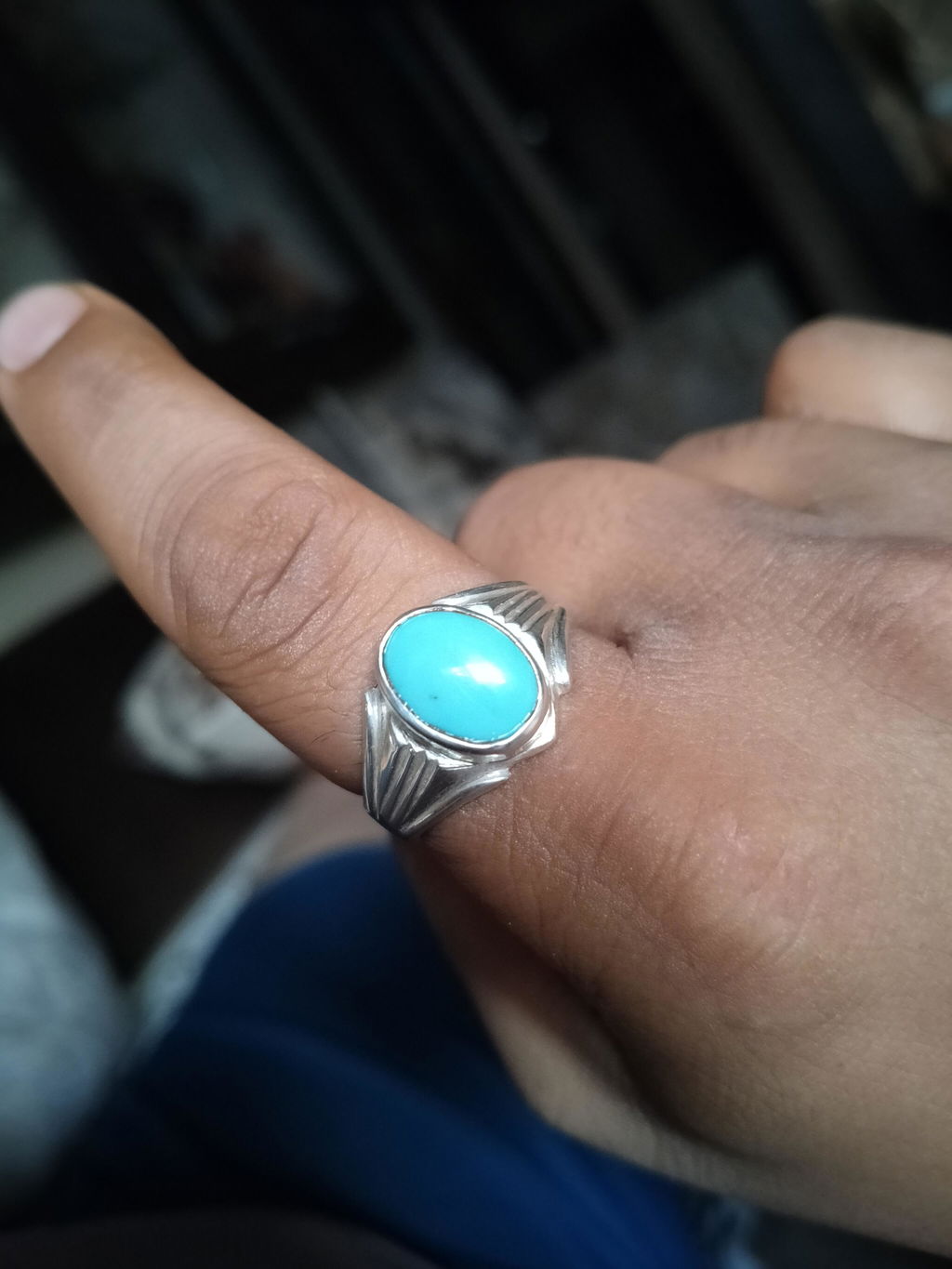
My piece leans slightly green rather than pure sky blue, and it matches the photos perfectly.
Abhi tak, chandi ka pendant banwaya gaya hai iska. Gale mein aasmani rang khil kar dikhta hai.
Dekhiye, sasur ji ko unke janamdin par diya. Unhone kaha ki jo pehle pehante the usse yeh zyada saaf hai. Bhoori nasein neele par bahut natural tarike se bikhri hain. Unki umar chhiyaasath hai aur unko chandi hi pasand aati hai.
To be fair, do hafte mein hi rang neele se hare hone laga. Pata tha ki porous hai phir bhi itni jaldi ki umeed nahi thi.
Waxy lustre hai, sheeshe jaisa nahi, yahi pehchan hoti hai.
Jeweller ko dikhaya toh usne turant kaha ki ye poori tarah prakritik hai, koi enhancement nahi. Uske hisaab se aaj kal aisa saaf untreated maal mushkil se milta hai. Rang aasmani hai aur usme patli patli bhoori nasein hain jo bahut khoobsurat lagti hain.
Rang mein halki variation hai ek kinare se doosre kinare tak. Mujhe yahi natural feel sabse zyada acha laga.
Chandi ki ring andar se thodi rough thi. Sunar se ghisva li. Aasmani rang aur patli nasein dono lajawab hain.
Salary ka bada hissa udhaar chukane mein chala jata tha. Ab thoda saans lene ki jagah bani hai.
The lab report lists the refractive index in the correct range and states unheated and untreated clearly.
Amrikan mine ka piece bataya gaya tha aur usme jo dark webbing hai wo rustic look deti hai. Kuch log saaf neela pasand karte hain par mujhe ye jaali wala pattern zyada bhaya. Silver mein jadne par contrast aur bhi ubhar kar aata hai.
Pichle saal ek local dukaan se firoza liya tha jo do mahine mein rang chhod gaya, saaf pata chal gaya ki wo asli nahi tha. Is baar research karke yahan se order kiya kyunki inhone unheated aur untreated clearly mention kiya hua tha. Jo piece aaya usme dark brown host rock ki nasein puri surface par failin hui hain aur neela bhi natural tarike se uneven hai. Chandi ki anguthi banwa kar daayen haath ki pehli ungli mein dhaaran kar liya hai.
The colour has deepened a shade over time, exactly as an untreated porous stone should behave.
Rang teen hafte mein thoda gehra ho gaya hai. Maloom tha ki aisa ho sakta hai phir bhi thoda ajeeb laga. Baaki maal genuine hai.
Live clip mein rang jitna chamakdaar dikha tha, asli mein utna nahi hai. Dhoop mein dekha toh thoda halka laga. Iske alawa koi shikayat nahi, banawat prakritik hai aur untreated hone ka pura bharosa hai. Chaar sitare isliye ki expectation thodi upar chali gayi thi.
Rate dekh kar pehle laga ki mehnga hai, phir doosri jagah compare kiya toh samajh aaya ki bina kisi kaam wale pathar ka daam yahi hota hai. 4582 mein aath ratti sahi deal hai. Report aur video dono milne se bharosa aur badh gaya.
Papa ko diya, unhone turant pehen liya khushi se.
The video sent before dispatch matched the stone exactly. No surprises at all when the parcel arrived.
Karz ki wajah se raat ko neend nahi aati thi, teen alag jagah se loan chal raha tha. Astrologer ne Brihaspati kamzor bataya aur firoza suggest kiya. Do mahine pehne hue ho gaye hain, sab kuch chuk toh nahi gaya par ek badi payment aa gayi jiski umeed chhod di thi. Mann par se bojh utra hai aur kharche par control bhi behtar hai ab. Pathar khud bhi bahut sundar hai, halka hara neela with fine kaali lakeerein.
Tarjani mein aath ratti ka pathar ekdum theek baith gaya hai. Naap maine bheja tha aur unhone bilkul waisa hi banaya.
Meri patni ne apni ungli ke liye chhota banwaya. Aasmani rang uske haath par bahut jachta hai.
Dhyan se dekha to, tula rashi hoon aur Shukra ke liye bataya gaya tha. Do hafte se pehen raha hoon, abhi bade badlaav ka dawa nahi karunga par mood definitely stable hai. Pathar dekhne mein hi itna sundar hai ki paisa vasool lagta hai. Oval dome par ungli phirane mein achha lagta hai.
Bina lag lapet, gift ke liye liya tha toh dibba thoda aur behtar hona chahiye tha. Pathar ne bacha liya, wo bahut sundar hai.
Immunity par asar dikha hai, is baar sardi ne zyada pareshan nahi kiya. Chandi mein pehanta hoon rozana bina naga.
Meri behen ko anxiety ki problem thi aur usne kaafi kuch try kiya tha. Firoza pendant pehnne ke baad usne khud bataya ki mann pehle se shant rehta hai. Rang halka neela hai aur uspar hari jhalak bhi hai jo dhoop mein dikhti hai.
My uncle is seventy and has worn turquoise in silver for decades. He inspected this one closely and said such veining cannot be faked. He also pointed out that untreated material is getting harder to find every year. Very happy that I trusted this store.
Bolne mein hichkichahat hoti thi meeting ke dauran. Kisi ne kaha ki ye pathar gale aur baat cheet se juda hua hota hai. Do mahine mein farak dikha hai, ab bina soche bol paata hoon. Rang bhi bahut soothing hai, thoda hara aasmani.
Anguthi dhili thi, adjust karwani padi. Pathar bahut acha hai.
Solah ratti ka option dekh kar hi maine yahan se liya. Itna bada piece kahin aur mila hi nahi.
Kaafi saal se main soch raha tha lekin har baar shak rehta tha ki kahin nakli na mile. Yahan lab certificate ke saath aaya aur bhejne se pehle video bhi. Webbing itni natural hai ki banana mushkil hai. Twenty percent discount ke saath rate bhi thik laga.
Dost ki shaadi mein gift dena tha aur kuch alag chahiye tha. Chandi ki anguthi mein firoza bahut classy option nikla. Dibba bhi decent tha isliye alag se packing nahi karni padi. Usne bataya ki uske ghar mein sabko pasand aaya.
Not Sure What to Buy?
Not Sure What to Buy?
Talk to our expert astrologers for 1:1 guidance.
- Personalized gemstone recommendation
- Based on your birth chart & planet positions
- Tips to wear & care for your gemstone

Our Promise to You

Certified by Reputed Gem Labs

100% Natural & Authentic

Select from live photos & videos

Get exactly what you select
Reasons why Turquoise is Best For You?


Reasons why Turquoise is Best For You?


Gemstone Care Instruction

Cleaning
After wearing, wipe your gemstone with a soft, dry cloth to remove sweat & dust.

Avoid Chemicals
Remove your gemstone before using soap, detergent, perfume, or sanitizer. When not in use, store it in coconut or baby oil inside a soft box.

Be Careful
Don’t hit or scratch your gemstone. Avoid heavy work or sports while wearing it.

Recharge
Recharge it using a Selenite plate or by placing it in sunlight/moonlight.


Things you want to know before purchase
What is the return policy?
Our goal is for every customer to be totally satisfied with their purchase. If this isn't the case, let us know and we'll do our best to work with you to make it right.
Are any purchases final sale?
We are unable to accept returns on certain items. These will be carefully marked before purchase.
When will I get my order?
We will work quickly to ship your order as soon as possible. Once your order has shipped, you will receive an email with further information. Delivery times vary depending on your location.
Where are your products manufactured?
Our products are manufactured both locally and globally. We carefully select our manufacturing partners to ensure our products are high quality and a fair value.
Related products
Frequently asked questions
On which finger to wear Turquoise (Firoza)?
Which metal is best for wearing Turquoise (Firoza)?
How many ratti of Turquoise (Firoza) should I wear?
How do I know if Turquoise (Firoza) is the right gemstone for me?
Is Turquoise (Firoza) real and certified?